

By Dirco Haasbroek
Having spent more than two decades in the hospitality industry, alongside my involvement in software development and technology, I’ve become increasingly aware of how much time hospitality professionals spend on tasks that could be automated.
From responding to reservation enquiries and preparing arrival lists to sending payment reminders, updating spreadsheets and compiling management reports, much of the daily workload involves repetitive administrative tasks.
These tasks are necessary, but they don’t necessarily contribute directly to a better guest experience.
What if we could reclaim some of that time?
What if the different software platforms we already use could communicate with one another without requiring someone to manually transfer information between them?
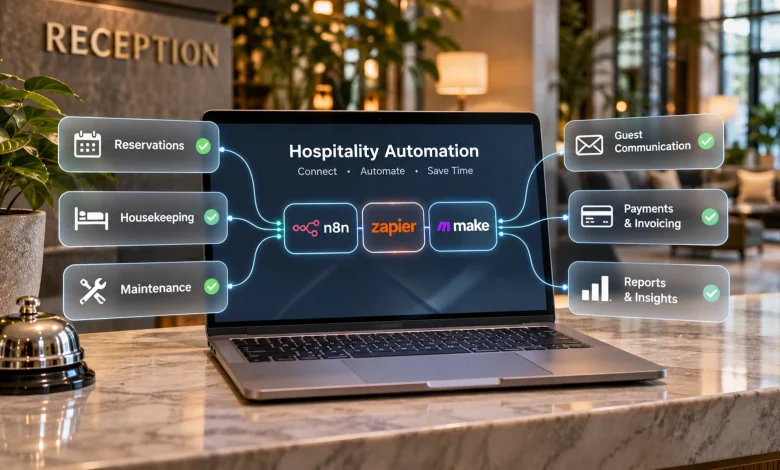
This is where automation platforms such as n8n, Zapier and Make present an exciting opportunity for the hospitality industry.
The Problem With Disconnected Systems
A typical accommodation establishment may use several different software platforms to manage its daily operations:
- Property management systems (PMS)
- Channel managers
- Online booking platforms
- Accounting software
- Payment gateways
- Customer relationship management systems (CRM)
- Email marketing platforms
- WhatsApp and email
- Housekeeping management systems
- Website enquiry forms
Individually, these systems serve an important purpose. The challenge is that they don’t always communicate effectively with one another.
Staff often find themselves copying information from one platform to another, downloading reports, updating spreadsheets and manually sending communications.
This creates unnecessary administrative work, increases the possibility of human error and makes it more difficult to maintain consistent operations.
Automation platforms can help bridge these gaps.
What Are Automation Platforms?
Platforms such as n8n, Zapier and Make allow businesses to connect different applications and create automated workflows.
In simple terms, when something happens in one system, it can automatically trigger an action in another.
For example, when a new reservation is received, an automated workflow could update a guest database, notify the relevant staff members, schedule a pre-arrival email and create a payment reminder.
All of this could happen in the background without requiring someone to manually complete each task.
Depending on the integrations available, these platforms can communicate with existing software through APIs, webhooks, email, databases and other supported connections.
The beauty of this approach is that you don’t necessarily need to replace your existing software. You can make your existing systems work better together.
1. Automating the Guest Journey
One of the most valuable applications of automation in hospitality is guest communication.
Imagine a guest journey where the following happens automatically:
- Reservation received: Send a personalised welcome message.
- Seven days before arrival: Send directions, local recommendations and information about the property.
- One day before arrival: Send an online check-in form and arrival instructions.
- On arrival: Notify the relevant team members.
- During the stay: Send a friendly message to check whether the guest needs assistance.
- After departure: Thank the guest and request feedback.
- Several months later: Send a relevant return-stay offer, where marketing consent allows.
These communications can be personalised using information from the reservation, including the guest’s name, room type, arrival date and booking preferences.
The objective is not to make communication robotic. It is to ensure that important communication happens consistently, even during the busiest periods.
2. Improving Housekeeping and Maintenance
Housekeeping is another area where automation can significantly improve operational efficiency.
Instead of manually preparing daily arrival and departure lists, an automated workflow could retrieve reservation information and generate a daily housekeeping schedule.
The schedule could be emailed to the housekeeping supervisor, shared through a staff dashboard or delivered through an approved messaging integration.
Maintenance can benefit in much the same way.
A housekeeper could report a broken appliance or leaking tap through a simple online form. An automation could then create a maintenance task, notify the responsible person and send a reminder if the issue remains unresolved.
Management gains better visibility, while staff spend less time following up on outstanding tasks.
3. Automating Payments and Accounting
Financial administration can consume a considerable amount of time, particularly for independent accommodation establishments.
Automation can assist with:
- Sending outstanding deposit reminders.
- Identifying reservations with unpaid balances.
- Generating invoices through integrated accounting software.
- Sending payment links to guests.
- Updating reservation payment statuses after verified payment confirmations.
- Preparing daily revenue summaries.
- Flagging transactions that require manual reconciliation.
For South African hospitality businesses, there are opportunities to connect booking systems with payment platforms such as PayFast and Yoco, as well as accounting solutions such as Sage, Pastel and Xero, depending on their available integrations.
Financial workflows should always include appropriate validation, security and approval processes, but the repetitive administration surrounding them can often be reduced significantly.
4. Turning Guest Feedback Into Action
Many accommodation establishments collect guest feedback but don’t necessarily have a structured process for acting on it.
An automated workflow could collect feedback from online surveys, guest emails or supported review platforms and organise it in a central database.
Artificial intelligence could assist in identifying recurring themes, such as cleanliness, Wi-Fi connectivity, breakfast quality or staff friendliness.
Management could receive immediate notifications when negative feedback requires attention, together with weekly summaries highlighting recurring concerns and opportunities for improvement.
Instead of simply collecting reviews, we can use technology to turn guest feedback into actionable information.
5. Smarter Marketing and Direct Bookings
Automation also creates opportunities to improve hospitality marketing without constantly increasing the marketing workload.
A property could automatically segment its consenting guest database according to previous stays, booking preferences or travel patterns.
Business travellers could receive relevant midweek accommodation offers, while leisure travellers could receive information about upcoming long weekends or seasonal packages.
Automation could also help identify repeat guests, track website enquiries and follow up on potential direct bookings.
Independent accommodation establishments often struggle to compete with the marketing budgets of large hotel groups and online travel agencies.
By making better use of their existing guest relationships, smaller properties can develop more targeted marketing strategies and potentially reduce their dependence on third-party booking platforms.
6. Management Reports Without the Manual Work
Imagine starting every morning with an automated report containing:
- Today’s arrivals and departures.
- Current occupancy.
- Upcoming reservations.
- Outstanding payments.
- Revenue performance.
- Recent guest feedback.
- Outstanding maintenance tasks.
- Occupancy forecasts.
Instead of logging into several different platforms to retrieve this information, management could receive a consolidated report directly in their inbox.
Automation can bring information together from multiple sources, making it easier to identify trends, respond to operational challenges and make informed business decisions.
The value isn’t simply in collecting more data. It’s in making the information accessible and useful.
7. Combining Automation With Artificial Intelligence
The combination of workflow automation and artificial intelligence opens even more possibilities.
AI can assist with categorising incoming enquiries, drafting personalised email responses, summarising guest feedback, translating communications and identifying information that requires management attention.
For example, an incoming accommodation enquiry could automatically be analysed to identify arrival dates, departure dates, the number of guests and specific requirements.
The workflow could then check availability through a supported booking system integration and prepare a response for a reservation agent to review.
This allows employees to respond more efficiently while maintaining control over the accuracy and quality of the communication.
AI doesn’t need to replace the reservation agent. It can become a valuable assistant to the reservation agent.
Choosing the Right Automation Platform
There are several platforms worth exploring, each with its own strengths.
n8n
A flexible workflow automation platform that offers self-hosting options, extensive API integration capabilities and the ability to build more advanced custom workflows. It is particularly attractive for businesses that want greater control over their infrastructure and data.
Zapier
An accessible platform with a large ecosystem of application integrations. It is well suited to businesses looking to implement straightforward automations without extensive technical knowledge.
Make
A visual automation platform that makes it possible to design complex workflows, transform data and connect multiple applications through an intuitive visual interface.
Microsoft Power Automate
A useful option for businesses already operating within the Microsoft ecosystem, particularly those using Outlook, Excel, SharePoint and Microsoft Teams.
There is no single platform that is right for every hospitality business. The decision should depend on existing software, technical requirements, budget, data protection and the complexity of the workflows.
Personally, I find n8n particularly interesting because of the flexibility it offers when developing custom integrations and connecting systems that don’t necessarily have ready-made integrations.
Automation Is Not Only for Large Hotels
There is a misconception that automation is something reserved for large hotel groups with substantial technology budgets.
I would argue that smaller accommodation establishments may have just as much to gain.
In many independent guesthouses, the owner is simultaneously responsible for reservations, marketing, accounting, guest relations, staff management and maintenance.
Saving even an hour a day on repetitive administrative tasks could make a meaningful difference.
A guesthouse does not need to automate its entire operation overnight.
Start with one repetitive task. Identify the process, determine whether it can be automated, implement a solution and measure the results.
Then move on to the next opportunity.
It is often the combination of several small automations that creates the greatest operational improvement.
Automation Should Not Replace Hospitality
This is perhaps the most important consideration.
Hospitality is fundamentally a people-focused industry.
Guests don’t visit an accommodation establishment because it has an impressive automation workflow running in the background.
They visit because they want somewhere comfortable to stay, somewhere they feel welcome and somewhere they can trust the people looking after them.
Technology should support that experience rather than replace it.
There will always be situations that require empathy, judgement, personal attention and genuine human interaction. Automation should also be implemented responsibly, with consideration for guest privacy, POPIA compliance, data security and the ability for staff to intervene when necessary.
The purpose of automation should be to give hospitality professionals more time to do what they do best: look after their guests.
The Future Is Connected
I believe the next significant opportunity in hospitality technology is not necessarily another booking platform, another property management system or another application.
It is making the systems we already use work together more effectively.
We need to move away from isolated software platforms towards connected operations where information flows between departments, applications and people.
Automation platforms such as n8n, Zapier and Make are making this increasingly achievable for businesses of different sizes.
The question hospitality owners should be asking is not simply, “What new software should I purchase?”
Perhaps a better question is:
“What am I doing manually every day that technology could be doing for me?”
The answer might reveal some of the greatest opportunities for improving your business.
Because the future of hospitality should not be about removing people from the industry.
It should be about removing unnecessary work so that people can focus on hospitality.
